Our approach

Conservative Dentistry: We Do Not Touch a Healthy Tooth

Conservative (minimally invasive) dentistry rests on the principle of doing only what the patient’s anatomy requires and avoiding unnecessary intervention. Where the same clinical result can be reached with less intervention, the tissue-preserving option is chosen. This is the main direction of the contemporary dental literature and the daily working rule of our clinic.

The reasoning is simple: tooth enamel is a tissue that does not regenerate. Enamel that has been cut away never returns, and every millimetre removed permanently narrows the tooth’s future treatment options. So every plan begins with the question “what is the smallest number of millimetres that will achieve this result?” — not “how much work can be made of this?”

For us this principle is a natural extension of specialist endodontics: endodontics is a speciality focused on saving teeth, and “save the tooth first” has been our founding principle.
In practice

Four rules in daily practice.

1 · 0.3–0.5 mm for a veneer

For a porcelain veneer only 0.3–0.5 mm of enamel is reduced from the front surface, preserving roughly ninety per cent of the tooth structure. In suitable cases a no-prep (prepless) veneer achieves the result with no reduction at all.

2 · A tooth that can be saved is not extracted

If the tooth can be saved with root canal treatment, that is recommended rather than extraction. No implant can replicate the periodontal ligament of a natural tooth, the sensation of chewing or the protection it gives the bone. Extraction is considered only where the tooth cannot be restored.

3 · A full crown is the last resort

Before moving to a full crown, bonding, minimal-prep veneers, whitening and orthodontic alignment are all considered. A crown is recommended only where the indication clearly calls for it.

4 · No pressure over appearance

The marketing language of “let us redo all your teeth” is not used at our clinic. No irreversible procedure is decided on without seeing the mock-up try-in and reading the written plan.

Digital planning

Touching less is only possible by planning more.

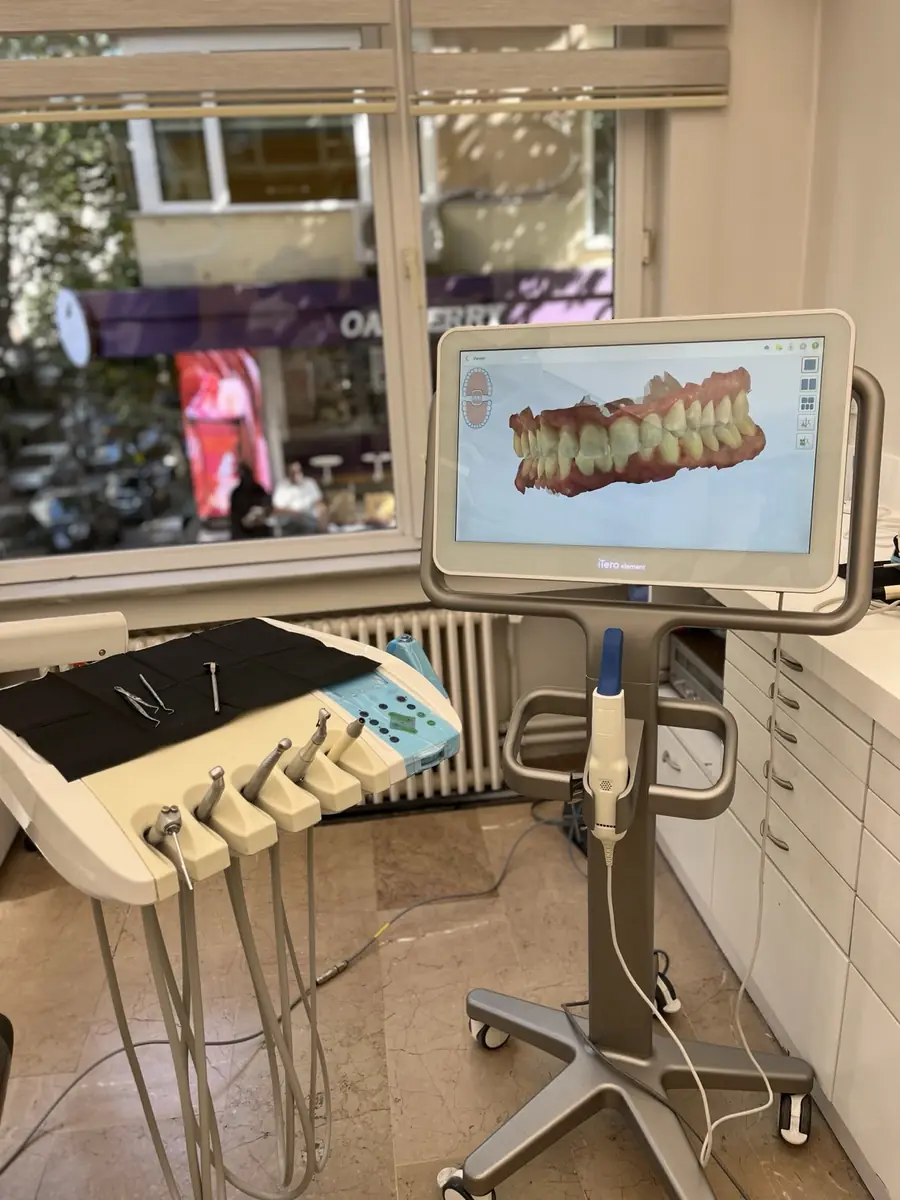
Conservative treatment planning with an iTero digital scan — GC Clinic Nişantaşı

Measurement and a try-in are the precondition for conservative work: your teeth are scanned in three dimensions with the iTero scanner, the target result is designed digitally and tried in your mouth as a mock-up (a temporary try-in). Because you see the result before any reduction, the irreversible step is left to last — unlike the “let us cut and see” approach — and in most cases it is never needed at all.

The same digital groundwork applies in microscopic endodontics too: under magnification only diseased tissue is removed and healthy dentine is left in place.

A comparison

The same aesthetic result, two different routes.

✓ What we prefer: a minimal-prep veneer

0.3–0.5 mm of enamel reduction (about 90% of the tooth preserved) · the tooth stays vital · strong adhesion because it bonds to enamel · can be replaced when needed · adds no risk of root canal treatment.

✗ What we generally advise against: a full crown for cosmetic reasons

Around 60–70% of the tooth structure is removed · the likelihood of needing root canal treatment rises · the crown bonds to dentine rather than enamel · it is irreversible · it is carried out only where the clinical indication requires it.

Across our treatments

How the conservative principle works across our four main treatments.

In veneers

0.3–0.5 mm in a standard case; in suitable cases a no-prep (prepless) veneer means zero reduction. In veneer treatment the aim is to add to the enamel, not to sacrifice it.

In root canal treatment

Under the microscope only infected tissue is removed; the access cavity is kept small and healthy dentine is preserved. A tooth that can be saved is not extracted.

In implants

An implant comes into question only where the tooth genuinely cannot be saved; planning is done with a scan, and no reduction is made to the sound neighbouring teeth for a bridge — that is the real conservative value of an implant.

In clear aligners

For mild crowding and gaps, rather than “correcting” by cutting the teeth we recommend alignment with clear aligners; the tooth tissue is left untouched and the result is lasting.

Examples of decisions

How conservative thinking works at the examination.

A colour problem

The first option is whitening or bonding; a veneer comes into question only if there is a structural problem as well. We do not recommend a full crown for colour.

Crowding

With mild crowding, orthodontic alignment with clear aligners is considered first; cutting the teeth down to “make them look straight” is the last resort.

Deep decay

In a tooth that is still vital, a filling or onlay comes first; root canal treatment is carried out only if the pulp is irreversibly affected. Extraction is reserved for a tooth that cannot be restored.

Frequently asked

About the conservative approach.

What is conservative dentistry?

It is the principle of choosing the tissue-preserving option wherever the same clinical result can be reached with less intervention: a healthy tooth is not touched, no unnecessary reduction is carried out, and irreversible procedures are deferred or avoided altogether.

Will my healthy teeth be touched?

No — the plan is built on the least possible intervention and is shared in writing; you do not decide without seeing the alternatives.

Why do some clinics recommend crowns on all the teeth?

Extensive crown plans are quick and commercially attractive; but the loss of sound tissue is irreversible. In a high-volume model the planning time per patient is short, whereas in a boutique model such as ours there is time to assess each tooth individually. We always support your seeking a second opinion.

What is a mock-up try-in?

It is the intended result tried out on your teeth in a temporary material; you see it in the mirror, speak with it and can change your mind. The irreversible stage is only reached with your approval.

Does this approach make treatment longer?

It sometimes adds an appointment or two; in return the tooth tissue and the long life of the tooth are preserved. The schedule is set out in the written plan from the start.

Is a no-prep veneer suitable for everyone?

No — it depends on tooth size, the bite and the smile line. Suitability is determined with a digital scan and a mock-up; if it is not suitable, the 0.3–0.5 mm minimal-prep option is considered.

Contact

Message us with a question or to book.

We would be glad to see you for a free consultation so you can view your treatment plan alongside its conservative alternatives.

Message us on WhatsApp