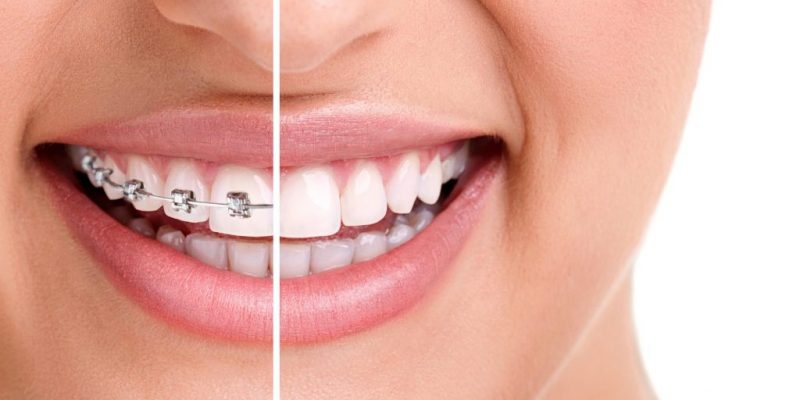
Orthodontic treatment corrects problems of bite and alignment without reducing or extracting teeth. For both adult and child patients we plan Invisalign clear aligners, lingual brackets and fixed brackets.
It is the speciality concerned with treating irregularities of the teeth and jaws.
Orthodontics is the dental speciality covering the treatment of crowding, gaps between teeth, bite problems (open bite, deep bite, crossbite) and jaw asymmetries. Treatment applies controlled forces so that the teeth move slowly into their new positions. Beyond appearance, the aim is also to bring the bite into harmony and restore correct chewing function.
Three main orthodontic methods are offered.
Invisalign (clear aligners)
Custom-made, removable sets of clear aligners. Changed every one to two weeks, they move the teeth gradually. Because they are taken out for eating and brushing, oral hygiene remains straightforward. This is the option most often chosen by our adult patients with aesthetic concerns.
Lingual brackets
A method in which the brackets are placed on the inner (lingual) surface of the teeth. As they cannot be seen from outside, they can be chosen by patients with high aesthetic expectations. The adaptation period is a little longer than with conventional brackets.
Fixed metal or ceramic brackets
Classic bracket systems bonded to the outer surface of the tooth. They offer the greatest control in complex bite problems and where large tooth movements are needed. Ceramic brackets offer a less noticeable alternative.
Orthodontics is considered in the following situations.
Crowding
Where teeth overlap one another or are out of line.
Gaps between teeth
For unwanted spaces between the teeth (diastema).
Bite problems
For open bite, deep bite and crossbite.
Orthodontics in children
For cases where jaw development can be corrected by early intervention.
Orthodontic treatment is carried out in five stages.
Consultation and imaging
Clinical examination, a panoramic X-ray and, where needed, CBCT imaging. The jaw structure is assessed with a cephalometric analysis.
Digital scan and treatment plan
An impression is taken with an intraoral digital scanner; a ClinCheck plan is prepared for Invisalign, and a wire plan for brackets.
Active treatment (6–30 months)
Active tooth movement begins with the chosen method. With Invisalign the aligners are changed every one to two weeks; with brackets the wire is adjusted every four to six weeks.
End-of-treatment check
Once the target position is reached, the aligners or brackets are removed. The result is photographed and the bite is verified clinically.
Retention protocol
To stop the teeth drifting back, a fixed lingual wire or a clear retainer worn at night is fitted. This stage is an inseparable part of the treatment.