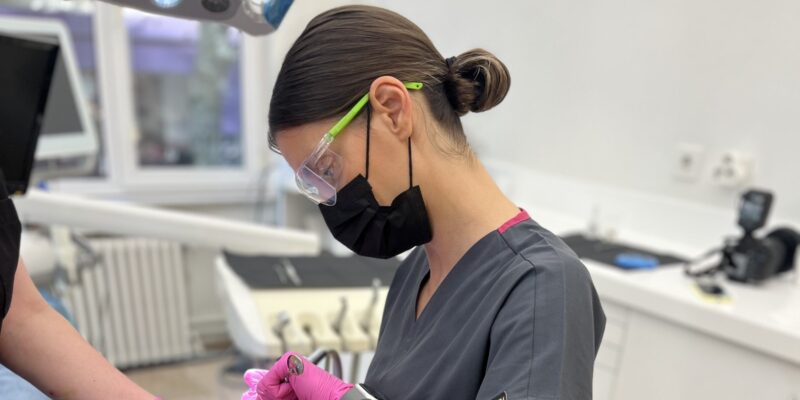
All root canal treatment is planned and carried out by Specialist Endodontist Cansu Öztürk. Complex cases and retreatment are worked under the microscope. A protocol in line with the ESE and AAE guidelines is fundamental.
Clearing the infection that has reached the nerve of the tooth (the pulp), and saving the tooth.
Root canal treatment (endodontic treatment) is used where the pulp tissue at the centre of the tooth has been damaged by infection, decay or trauma. At our clinic in Nişantaşı, Istanbul, all root canal treatment is planned and carried out by a specialist. During treatment the pulp tissue is cleared through the canal system, the canal is shaped, disinfected and filled with a biocompatible material. In this way the tooth is kept in place and its function preserved. As an alternative to extraction and an implant, root canal treatment is one of the core procedures of the conservative approach, in which the natural tooth is preserved.
At our clinic every root canal treatment is carried out by a Specialist Endodontist.
Endodontics is the dental speciality concerned with diseases of the tooth pulp and with root canal treatment. In Turkey the specialist training requires a further four years of academic study after the general dental degree.
Cansu Öztürk — Specialist Endodontist
After graduating from the Faculty of Dentistry at Ege University in 2010, she completed her specialist training in the Department of Endodontics at Marmara University between 2012 and 2016. The paper based on her specialist thesis was published in the peer-reviewed journal Operative Dentistry in 2018.
She is an active member of the ESE (European Society of Endodontology) and the AAE (American Association of Endodontists); the ESE Quality Guidelines are the core reference for our practice.
Root canal treatment is typically completed in four steps.
Diagnosis and imaging
The diagnosis is made with a clinical examination, a periapical X-ray and, where needed, CBCT imaging. The number of canals, the anatomy and the spread of infection are assessed.
Local anaesthesia and access cavity
Local anaesthesia is given and an access cavity is opened to reach the pulp chamber. Care is taken to preserve sound tooth tissue.
Mechanical cleaning and disinfection
The canals are shaped with mechanical instruments, then irrigated with sodium hypochlorite and further disinfectant solutions. Complex cases are worked under the microscope.
Filling the canal and the permanent restoration
The canal is filled with gutta-percha and a biocompatible sealer. The permanent restoration (a composite filling, an inlay or a crown) is completed within two weeks at the latest.
If you think your earlier root canal treatment has failed.
Retreatment is carried out on teeth that have had root canal treatment before but where it has failed or become reinfected. These cases are more complex than standard root canal treatment and require working under the microscope. The old filling material is removed, the canals are cleaned and disinfected again and refilled.
Retreatment carries a 2-year written guarantee. Endodontic retreatment is one of our clinic’s areas of expertise.
Choosing between root canal treatment and extraction with an implant.
When root canal treatment is preferred
When extraction and an implant are needed
We make the decision after the clinical findings and imaging — not on a “same treatment for every tooth” basis.